Scaling Circularity: From Pilot Projects to Proven Practice
My perspective from METAMORPHOSIS
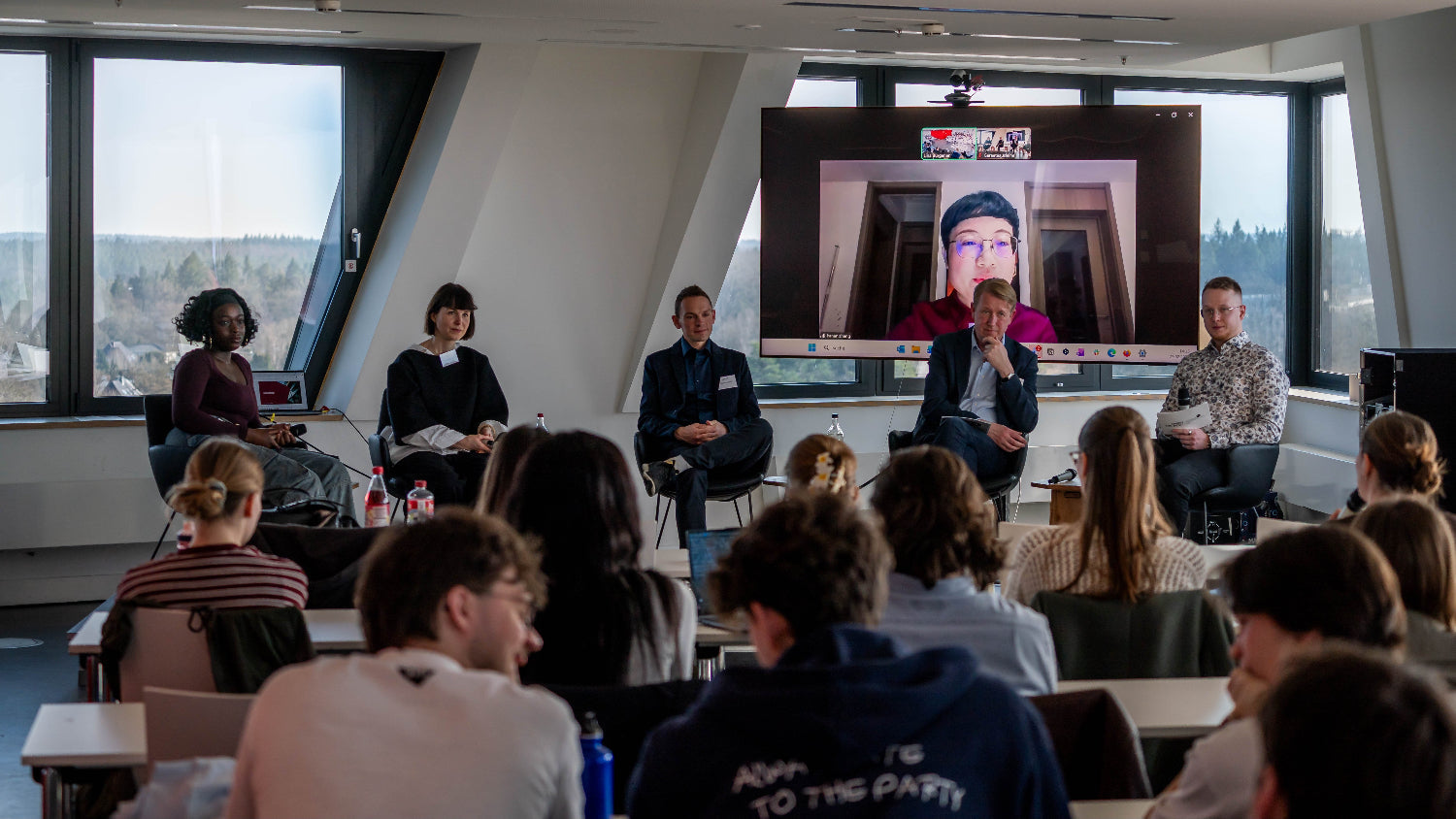
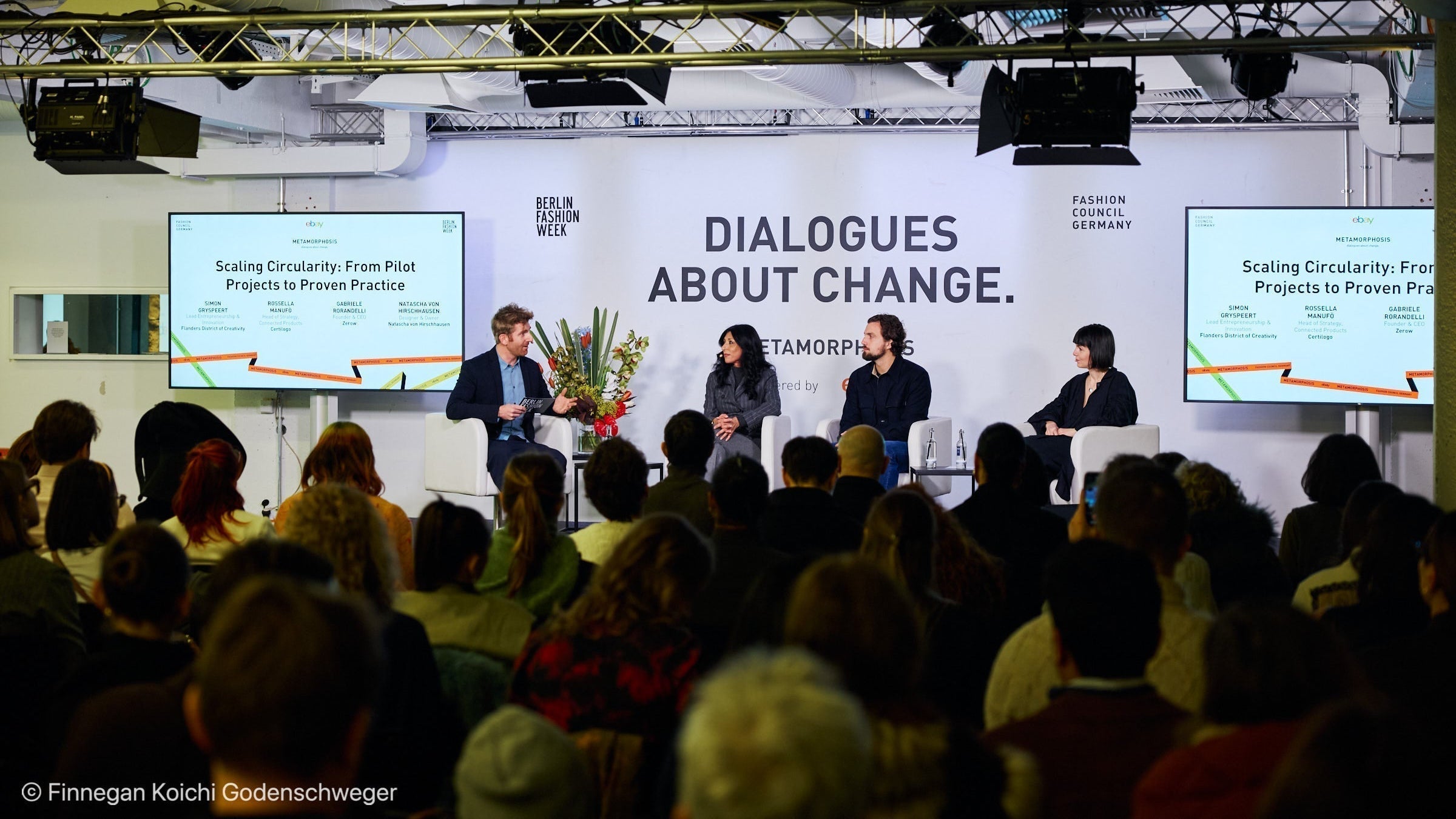
How can circularity move beyond pilot projects and become a proven, scalable practice? This question was at the center of the panel “Scaling Circularity: From Pilot Projects to Proven Practice” at METAMORPHOSIS – dialogues about change, organised by the Fashion Council Germany and Masjien Agency in partnership with eBay Germany, and held during Berlin Fashion Week.
The panel brought together perspectives from design, technology and innovation to explore how brands and pioneers navigate obstacles, build the right systems and unlock greater impact through reuse and long-life business models. I joined the discussion alongside our host Simon Gryspeert (Lead Entrepreneurship & Innovation, Flanders District of Creativity), Rossella Munafò (Head of Strategy, Connected Products at Certilogo) and Gabriele Rorandelli (Founder & CEO of Zerow).

Circularity starts with design — not with scale
From my perspective as a designer and founder, circularity cannot be added later in the process. It starts with design decisions: materials, construction, adaptability and longevity. Only products designed for long lifespans can realistically become part of reuse, repair and circular systems that work beyond experimental phases.
In an industry still shaped by short cycles and fast consumption, this requires a fundamental shift — away from producing more, towards creating longer-lasting value per product.
From reuse concepts to viable business models
During the panel, we discussed how reuse and long-life strategies can evolve into scalable business models. For me, longevity is not a limitation to growth; it is a strategic advantage. Designing garments that can be repaired, altered and worn over time enables multiple life cycles and builds a stronger relationship between product, wearer and brand.
For circularity to scale, it has to be treated as a core business principle, not a side project. That means aligning creative vision with operational systems — from production and pricing to repair, reuse and after-use solutions.
Scaling circularity not production: impact over turnover
For me, impact over turnover has become a guiding principle when thinking about scale. Scaling does not have to mean producing more products or increasing volume. Instead, I chose to grow impact through education, teaching, coaching and consulting. This approach allows circular design principles to reach far beyond my own label. In parallel, we collaborate with other brands to implement zero-waste design strategies — through co-branded projects as well as design as a service. By working within existing brand structures, circularity can be embedded at the design level, reducing waste at the source while enabling systemic change.
Designing systems, not just products
The discussion at METAMORPHOSIS made one thing clear to me: scaling circularity is not only a technical challenge, but a cultural and entrepreneurial one. It takes patience, clarity of values and the willingness to question established industry logics.
Circularity becomes viable when design is understood not as an endpoint, but as the starting point of a system — one that supports products throughout their entire lifecycle and turns vision into practice.

All Fotos: Finnegan Godenschweger for FCG